Sustainable agriculture is a farming approach that meets current food needs without harming future generations, focusing on environmental health, economic viability, and social equity by using practices like crop rotation, water conservation, and reducing synthetic inputs, aiming to build healthy soils, protect biodiversity, and conserve resources for long-term food security.
How to get involve in Sustainable Practices in Farming
Crop Rotation & Polyculture: Growing diverse crops in sequence or together to improve soil, manage pests, and reduce chemical needs.
Cover Cropping: Planting non-cash crops (like legumes) to prevent erosion, add nutrients (nitrogen-fixing), and suppress weeds.
Integrated Pest Management (IPM): Using biological, cultural, physical, and chemical tools to manage pests with minimal environmental impact.
Water Management: Efficient irrigation, rainwater harvesting, and water-saving techniques.
Agroforestry: Integrating trees and shrubs with crops or livestock to create diverse, productive systems. Example Food forest.
Composting: Recycling organic waste to build soil fertility.
Composting
Farm residues , weeds and waste could be turn into nutrient-rich soil amendment, vital for healthy plants by improving soil structure, water retention, and feeding beneficial microbes, using layered "browns" (carbon) and "greens" (nitrogen), keeping it moist and aerated, ready in months to boost crop yield and quality naturally. Key steps involve layering carbon-rich (leaves, straw) and nitrogen-rich (manure, kitchen scraps) materials in a pile or trench, moistening it, turning it regularly, and waiting for it to turn dark, earthy, and crumbly, signifying readiness for planting to provide essential NPK and beneficial microorganisms.
Composting for farming turns farm waste into "black gold" (compost), a rich soil amendment that boosts fertility, improves soil structure, water retention, and nutrient availability, reducing reliance on chemical fertilizers while fighting erosion and enhancing crop health. Farmers create compost by layering carbon-rich (dry) and nitrogen-rich (wet) materials with water and microbes, then managing the pile for decomposition, resulting in a stable, nutrient-dense fertilizer that strengthens soil biology and supports sustainable agriculture.
Why Farms Use Compost
Enhances Soil Health: Adds stable organic matter, feeds soil microbes, improves structure (aeration, water holding), reduces erosion, and increases nutrient capacity (CEC).
Boosts Fertility: Slowly releases nutrients (N, P, K) and introduces beneficial organisms, reducing the need for synthetic fertilizers.
Suppresses Pests & Diseases: A healthy soil biome from compost can naturally suppress plant pathogens and weeds.
Reduces Waste: Turns crop residues, animal manure, and other organic discards into a valuable resource

Swales in Farming
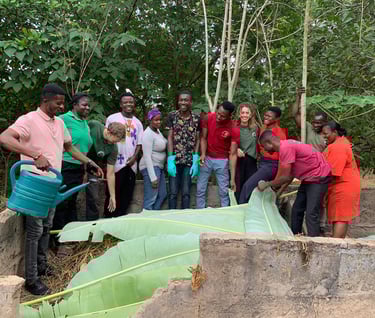
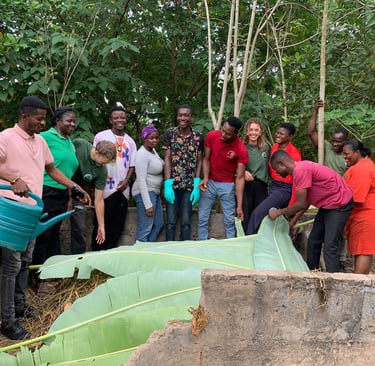
Video on how we educated two german`s Students on how to make organic compost at our training centre.
Biochar production involves heating organic material (biomass) in a low-oxygen environment through a process called pyrolysis, converting it to a stable, carbon-rich charcoal that improves soil health, captures carbon, and manages waste. Methods range from simple backyard pits and drums to complex industrial systems, all relying on controlled heating (350°C to 1000°C) to drive off moisture and gases, leaving behind porous carbon.
A fine-grained, highly porous type of charcoal made from biomass, biochar (despite the futuristic name) has been used by humans for over two thousand years as a soil enhancer. It helped to increase crop yields while sustaining essential soil biodiversity. One of the most well-known instances of naturally occurring biochar is in the Amazon, where native peoples there used (and still use) “terra preta” in their agricultural practices.
WHY BIOCHAR IS IMPORTANT FOR ENVIRONMENTAL SUSTAINABILITY
Biochar as carbon capture
Combustion—when materials burn in the presence of an oxygen-rich atmosphere—releases GHGs into the air, most notably carbon dioxide. In contrast, pyrolysis leaves most of the carbon in the original biomass trapped in a solid form. If, as an example, someone were to chop up a fallen tree and put it into a kiln, most of the carbon that the tree absorbed from the atmosphere over the course of its life would stay in the resulting biochar (which would be much smaller in volume than the original amount of wood).
One ton of biochar sequesters (stores) carbon that would have otherwise generated 3.6 tons of carbon dioxide if left to degrade by natural processes. As a form of thermochemical conversion, biochar not only valorizes waste, but it’s a very effective method for capturing carbon and storing it in a solid state that can remain stable for centuries.
Sustainable energy through pyrolysis
Much of Sweden’s capital city’s heating comes from something most people don’t think about more than once or twice a year: yard waste. The Stockholm municipality collects sticks, leaves, and other trimmings from residences and parks to not only make biochar, but to capture a gas by-product of pyrolysis that works just the same as natural gas. The only difference is that it’s not a fossil-based fuel. The biochar itself is then delivered to gardeners and farmers to help them grow healthy plants.
In addition to clean energy and a circular soil amendment, the Stockholm Biochar Project is achieving a third, critical goal in support of the city’s plan to completely decarbonize: It is sequestering carbon from the atmosphere.
As an industrial material
A growing number of scientists and policymakers have turned to biochar as a powerful yet simple solution for addressing the climate challenges that follow from organic wastes like sewage, food, and agricultural by-products. A recent paper indicated that converting waste produced by China’s massive corn-growing industry into biochar could reduce the sector’s overall GHG emissions by 20 percent or more.
Kathleen Draper, a biochar researcher and board member of the International Biochar Initiative (IBI), is a long-time advocate for new uses of biochar beyond soil enrichment. She wants to see biochar applied in many more ways, whether as an additive for construction materials like cement and concrete or as a manufacturing material that can be used to make plastics. Ultimately, Draper’s research seeks to unlock biochar’s full potential as a carbonate material that can be combined with others to make strong, durable composites for industrial use. If successful, such applications would valorize unsustainable waste streams while sequestering carbon.
The majority of biochar today is made from plant and animal biomass like residential plant trimmings, food processing residues, or forestry cuttings because it’s used to improve soils. Researchers like Draper believe that widening what feedstocks can be used to make biochar will, in turn, open new applications. Namely, they have in mind problematic sources of waste like sewage from treatment plants. These types of biomass could be pyrolized to make bitumen, carbon fibers, and other industrial materials currently made from fossil fuels.
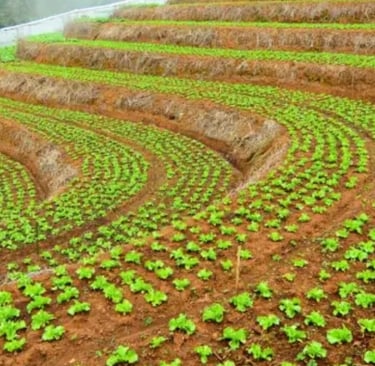
CONTOUR FARMING
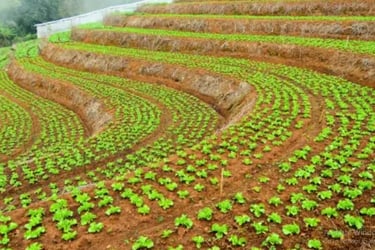
Contour farming, the practice of tilling sloped land along lines of consistent elevation in order to conserve rainwater and to reduce soil losses from surface erosion. These objectives are achieved by means of furrows, crop rows, and wheel tracks across slopes, all of which act as reservoirs to catch and retain rainwater, thus permitting increased infiltration and more uniform distribution of the water.
Contour farming has been practiced for centuries in parts of the world where irrigation farming is important. Although in the United States the technique was first practiced at the turn of the 19th century, straight-line planting in rows parallel to field boundaries and regardless of slopes long remained the prevalent method. Efforts by the U.S. Soil Conservation Service to promote contouring in the 1930s as an essential part of erosion control eventually led to its widespread adoption.
The practice has been proved to reduce fertilizer loss, power and time consumption, and wear on machines, as well as to increase crop yields and reduce erosion. Contour farming can help absorb the impact of heavy rains, which in straight-line planting often wash away topsoil. Contour farming is most effective when used in conjunction with such practices as strip cropping, terracing, and water diversion.


Biochar
Contour Vegetable farming
Swales in farming are level ditches dug along land contours to capture and infiltrate rainwater, slowing runoff, preventing erosion, and hydrating the soil and plants (like trees and berries) on the downhill berm. This permaculture technique mimics natural water retention, creating fertile, moist zones that reduce irrigation needs and build resilient, drought-resistant food forests and grazing lands, effectively spreading water throughout a property.
How Swales Work
Contour Digging: Swales are dug to follow the natural curve (contour) of the land, not straight down a slope.
Water Interception: When it rains, water flowing downhill hits the swale, gets caught, and pools.
Slow Infiltration: The water slowly soaks into the soil over time, recharging groundwater.
Berm Creation: The soil removed from the ditch forms a mound (berm) on the downhill side, perfect for planting.
Benefits in Farming
Water Conservation: Drastically reduces water runoff and increases soil moisture.
Erosion Control: Stops soil and nutrients from washing away.
Increased Fertility: Captures organic matter, creating fertile soil along the swale.
Passive Irrigation: Continuously waters plants (fruit trees, shrubs, etc.) planted on the berm.
Drought Resilience: Hydrates a larger area of land, making it more resilient to dry spells.
Improved Grazing: Can create lush forage areas for livestock, even in dry conditions.
AGROFORESTRY(Foodforest)
Agroforestry is a sustainable land management system that intentionally integrates trees and shrubs with crops or livestock, blending agriculture and forestry for diverse benefits like improved soil health, increased biodiversity, better water management, enhanced food security, and climate resilience, offering economic and environmental advantages over conventional farming. It creates productive, resilient ecosystems by using woody perennials to provide shade, fodder, fuel, or fruit, while also preventing erosion and sequestering carbon, supporting smallholder farmers and rural livelihoods globally.
Moreover, this is the interaction of agriculture and trees, including the agricultural use of trees. This comprises trees on farms and in agricultural landscapes, farming in forests and along forest margins and tree-crop production, including cocoa, coffee, rubber and oil palm. Interactions between trees and other components of agriculture may be important at a range of scales: in fields (where trees and crops are grown together), on farms (where trees may provide fodder for livestock, fuel, food, shelter or income from products including timber) and landscapes (where agricultural and forest land uses combine in determining the provision of ecosystem services)
Agroforestry involves a wide range of trees that are protected, regenerated, planted or managed in agricultural landscapes as they interact with annual crops, livestock, wildlife and humans.
As natural forests are cleared for agriculture and other types of development, the benefits that trees provide are best sustained by integrating them into agriculturally-productive landscapes.
Benefits of Trees
Trees play a crucial role in almost all terrestrial ecosystems and provide a range of important products and services to both rural and urban communities. Most trees have multiple uses, including cultural ones, and typically provide a range of benefits. They have also been used as land-boundary markers and to confer land-use rights. Trees are fundamental for land regeneration to improve soil health.
In short, there is nothing better than a tree to simultaneously:
Sequester carbon from the atmosphere
Bring up water and nutrients from deep in the ground
Provide a framework for above- and belowground biodiversity to flourish
Build soil organic matter and thus soil carbon
Create regulating micro-climates
Provide fodder and shelter for livestock
Innovate diversified farm enterprises
Make agricultural landscapes more resilient
Record climate history
What is Foodforest?
A food forest, also known as a garden forest or Agroforestry, involves planting perennial edible plants in a manner that mimics natural Forest. They are typically three-dimensional in design and include eight layers (the overstory, the understory, the shrub layer, the herbaceous layer, the root layer, the ground cover layer, the vine layer, and the mycelial layer).
When growing in layers, we can grow more food in less space, all while improving the soil web and the health of the plants. According to the World Economic Forum, there are over 400,000 edible perennial plants. That's a lot to choose from!
A food forest does not have to be re-planted year after year. Once it is established, it is generally very resilient. Deer and rabbits might come and munch some of the herbaceous edibles in some areas, for example, but other species will not be palatable to them or will be out of their reach. Or perhaps some children will come running through the area in wild play, running off path and possibly causing some damage to the ground cover and herbaceous layers. Not only will they usually grow right back, since many will be perennials and have healthy underground systems, but the trees, shrubs, and vines should be undamaged.


8 Layers in foodforest
ORGANIC PESTICIDES
Organic pesticides are natural alternatives to chemical pesticides used to control pests and diseases in crops. Organic materials such as plants, minerals, and microorganisms are used to create these natural pesticides. Organic pesticides are intended to protect crops from pests and diseases while posing no risk to the environment, beneficial insects, or human health.
Organic pesticides are a necessary part of organic farming practises. They provide farmers with environmentally friendly, safe, and long-lasting pest management tools. Organic pesticides also contribute to the preservation of healthy ecosystems by preserving natural habitats and encouraging biodiversity. Organic pesticides, as opposed to conventional pesticides, work by utilising natural mechanisms of action. Some organic pesticides, for example, contain plant extracts that repel pests, while others use microorganisms found naturally in soil to control diseases. Organic pesticides are frequently used in conjunction with other cultural practises, such as crop rotation and intercropping, to prevent pest and disease buildup in the soil.
Making organic pesticides can be a simple and low-cost way for farmers and gardeners to manage pests and diseases without using harmful chemicals. Here are some instructions for making your own organic pesticide:
Identify the pest or disease you want to control.
Choose an organic material that has natural pest control properties. For example, neem oil, garlic, and hot pepper can all be effective against certain pests.
Mix the organic material with water to create a solution. The concentration of the solution will depend on the specific organic material you are using and the pest or disease you are trying to control.
Apply the organic pesticide to the affected area using a spray bottle, watering can, or other suitable applicator.
While organic pesticides are generally thought to be safe and effective, they should be used with caution and in accordance with proper guidelines. Always read the label and carefully follow the instructions. Furthermore, it is critical to remember that organic pesticides are not a panacea for pest and disease control. They should be used in conjunction with an integrated pest management strategy that includes cultural practises, monitoring, and application at the appropriate time.
Organic pesticides are organic alternatives to conventional pesticides that are designed to protect crops from pests and diseases without harming the environment, beneficial insects, or human health. Making your own organic pesticides is a simple and effective way to manage pests and diseases in an environmentally friendly manner.
For organic farming in Ghana, popular pesticides center around Neem Oil (disrupts pests, repels insects) and homemade concoctions like Garlic/Onion sprays, Soap/Citrus mixtures, and even Chrysanthemum tea, all effective against common pests like armyworms, aphids, and caterpillars. Local producers are also developing commercial neem-based products showing growing local capacity for sustainable pest control, reducing reliance on chemicals while boosting local livelihoods.
Key Organic Pesticides & Controls in Ghana:
Neem Oil: Highly versatile, contains azadirachtin to disrupt insect growth; mix with water and a drop of soap for spraying.
Garlic/Onion Spray: Mince garlic/onion, steep in water, and spray to repel pests.
Insecticidal Soap: Kills soft-bodied pests like aphids and whiteflies.
Diatomaceous Earth (DE): A powder that dehydrates pests like slugs and insects.
Bacillus thuringiensis (Bt): A naturally occurring bacterium effective against caterpillars.
Neem Seed Extract: Proven effective for Diamondback Moth and Fall Armyworm control in Ghana.
MIX CROPPING AND CROP ROTATION
Connect
Join us in making a difference.
Follow
Contact
info@millenniumgreencare.com
+233246902198
© 2025. All rights reserved.